2026 AI Infrastructure Roadmap: From Planning to Production
Your team approved infrastructure budgets in Q4 2025, but traditional deployment timelines mean no capacity until 2027. With AI infrastructure spending projected to reach $280 billion in 2026, the path you choose today determines your competitive position for the next 24 months.

If your organization approved AI infrastructure investments in late 2025 but you're still evaluating deployment options, you're not alone. The challenge is that evaluation paralysis comes with a steep cost: every month of delay in Q1 2026 pushes your deployment timeline deeper into 2027 using traditional approaches.
According to Gartner's October 2025 forecast, AI infrastructure spending will reach $280 billion in 2026, with datacenter systems growing 19% to $582.4 billion. The enterprises capturing this market opportunity are those deploying infrastructure in 3-4 months, not 18 months.
The AI Infrastructure Planning Crisis
Most infrastructure teams face the same dilemma: they need GPU-ready capacity on compressed timelines, targeting 2026 production windows rather than 2027 completion dates, but traditional data center builds require 18-24 months from planning to production. The math doesn't work.
The Timeline Reality
- • Traditional Data Center Build: 18-24 months average (Uptime Institute 2025)
- • Equipment Lead Times: 12-18 months for critical components (generators, switchgear, chillers)
- • Project Delays: 73% of projects exceed original timeline by 6+ months
- • Cost Overruns: 98% of megaprojects face cost increases averaging 80%
The competitive pressure is real. AI-optimized Infrastructure-as-a-Service spending is projected to grow from $18.3 billion in 2025 to $37.5 billion in 2026, representing 146% year-over-year growth according to Gartner. Companies that secured GPU-ready infrastructure for H1 2026 are capturing market share while competitors are still negotiating construction contracts.
Q1 2026: The Critical Decision Window
The window to commission infrastructure for 2026 production has narrowed significantly. Projects starting now with traditional builds won't complete until late 2027 at the earliest. Here's why: even with aggressive timelines, traditional builds require 18-24 months from ground-break to go-live.
Infrastructure Procurement Lead Times
The Uptime Institute's 2025 Global Data Center Survey identified equipment availability as a top concern. Critical components face unprecedented lead times:
Long-Lead Equipment
- • Generators: 12-16 months
- • Switchgear: 14-18 months
- • Large Chillers: 12-15 months
- • UPS Systems: 10-14 months
- • Transformers: 12-16 months
Price Escalation (Q3 2021 baseline)
- • Switchgear: +50%
- • UPS Systems: +48%
- • Generators: +45%
- • Transformers: +44%
- • Chillers: +40%
Equipment orders placed today carry 12-18 month delivery windows, meaning delivery won't occur until mid-to-late 2027. Add construction time, commissioning, and inevitable delays, and you're looking at Q4 2027 at the earliest for production deployment.
AI Infrastructure Planning Checklist
Before evaluating deployment options, conduct a thorough requirements assessment. This 47-point checklist covers the critical decision factors:
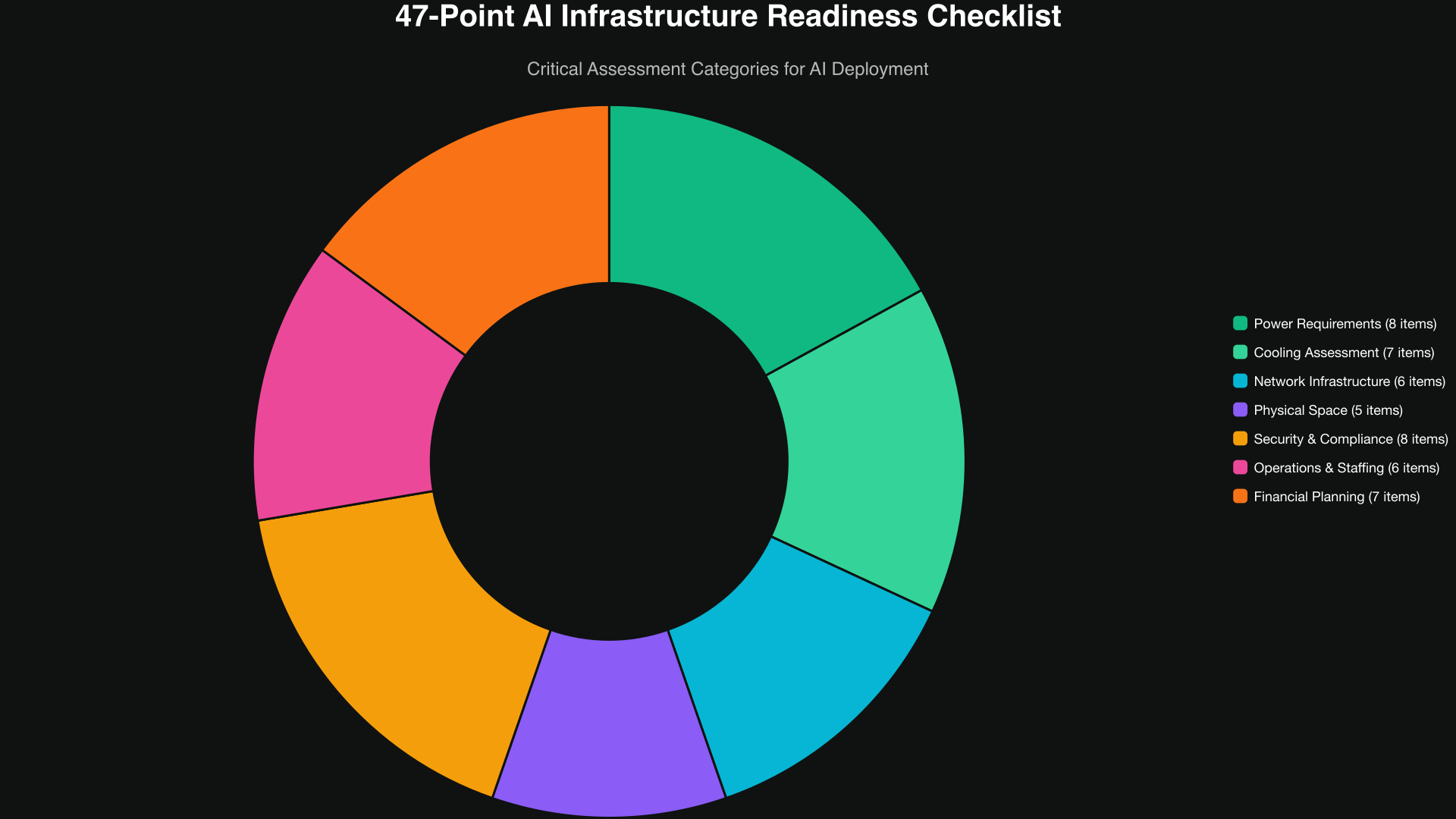
Power Requirements Assessment
- → Total Power Capacity: Calculate kW per rack and total MW requirements
- → Power Density: Modern GPU racks require 40-75kW per rack (vs 10-15kW traditional)
- → Redundancy: N+1 minimum for production AI workloads, N+2 for mission-critical
- → Utility Availability: Dual utility feeds, adequate transformer capacity
Cooling Methodology Selection
- → Air Cooling Limits: Traditional CRAC units max out at 15kW per rack
- → Liquid Cooling Requirements: Direct-to-chip mandatory for 40kW+ density
- → PUE Targets: Modern liquid-cooled facilities achieve 1.2-1.3 (vs 1.5-1.7 air-cooled)
Timeline and Budget Constraints
- → Target Operational Date: When do you need production capacity online?
- → Budget Flexibility: Can you absorb 80% cost overruns? (industry average)
- → Opportunity Cost: What's the revenue impact of 6-12 month deployment delays?
Deployment Paths Compared
Four primary deployment strategies exist for AI infrastructure in 2026. Each offers distinct trade-offs in timeline, cost, control, and risk:

Option 1: Traditional Data Center Build
Advantages
- • Full ownership and control
- • Custom design for specific needs
- • Long-term asset value
- • Unlimited scaling potential on-site
Disadvantages
- • 18-24 month deployment timeline
- • $8-12M per MW capital investment
- • 98% face cost overruns (avg 80%)
- • Construction and design risk
- • Requires facility management expertise
Best For: Organizations with 24+ month planning horizons, internal data center expertise, and budgets that can absorb significant overruns.
Cost: $8-12M per MW (Cushman & Wakefield 2025), up to $20M+ for AI-optimized facilities
Timeline: 18-24 months minimum, 73% exceed original timeline
Option 2: Modular Container Deployment
Advantages
- • 3-4 month deployment timeline
- • Fixed pricing, zero cost overruns
- • Factory-tested before delivery
- • Designed for 40-75kW GPU density
- • Incremental capacity expansion
- • Full ownership after deployment
Disadvantages
- • Still requires site preparation
- • Limited customization options
- • Standardized configurations
- • Requires adequate site infrastructure
Best For: Organizations needing near-term 2026 deployment, seeking ownership without construction risk, requiring GPU-ready infrastructure.
Cost: Fixed pricing based on capacity, typically 30-40% lower TCO than traditional builds
Timeline: 3-4 months guaranteed, factory built and tested before delivery
Industry Examples: Google's container data centers, Microsoft Azure modular facilities, Schneider Electric EcoStruxure deployments
Option 3: Enterprise Colocation
Advantages
- • Immediate or near-immediate deployment
- • Zero capital expenditure
- • Professional facility management included
- • High uptime SLAs (99.99%+)
- • Compliance certifications in place
Disadvantages
- • Monthly OpEx vs CapEx
- • Less control over infrastructure
- • Contract terms and commitments
- • Legacy facilities may not support GPU density
Best For: Immediate capacity needs, avoiding CapEx, lacking internal facilities expertise, testing infrastructure strategy before major investment.
Cost: $180-250 per kW per month (GPU-ready facilities), 3-5 year contracts typical
Timeline: 72 hours to 30 days depending on available capacity
Option 4: Hybrid Deployment Strategy
Many enterprises are adopting a phased approach: start with colocation for immediate needs, deploy modular containers for medium-term capacity, and maintain cloud for burst workloads and geographic distribution.
Phase 1 (Immediate)
Deploy in enterprise colocation facility within 30 days
Phase 2 (90 Days)
Add modular container capacity for owned infrastructure
Phase 3 (Ongoing)
Maintain cloud for geographic distribution and burst capacity
Real Deployment Timeline: Modular vs Traditional
Let's compare actual timelines for a 2MW AI infrastructure deployment using both traditional and modular approaches:
| Phase | Modular Container | Traditional Build |
|---|---|---|
| Requirements & Vendor Selection | Week 1-2 | Month 1-2 |
| Design & Permitting | Week 3-4 | Month 3-6 |
| Equipment Procurement | Pre-ordered (included) | Month 7-18 |
| Site Preparation | Week 1-4 | Month 6-9 |
| Construction/Manufacturing | Week 4-8 (factory) | Month 9-20 |
| Testing & Commissioning | Week 9-12 | Month 21-24 |
| Total Timeline | 60-90 Days | 18-24 Months |
| Typical Delays | Rare (factory controlled) | 73% exceed timeline by 6+ months |
The modular advantage comes from parallelization: while your site is being prepared, the container is being manufactured and tested in a factory environment. Traditional builds are sequential: each phase must complete before the next begins.
ROI Analysis and Total Cost of Ownership
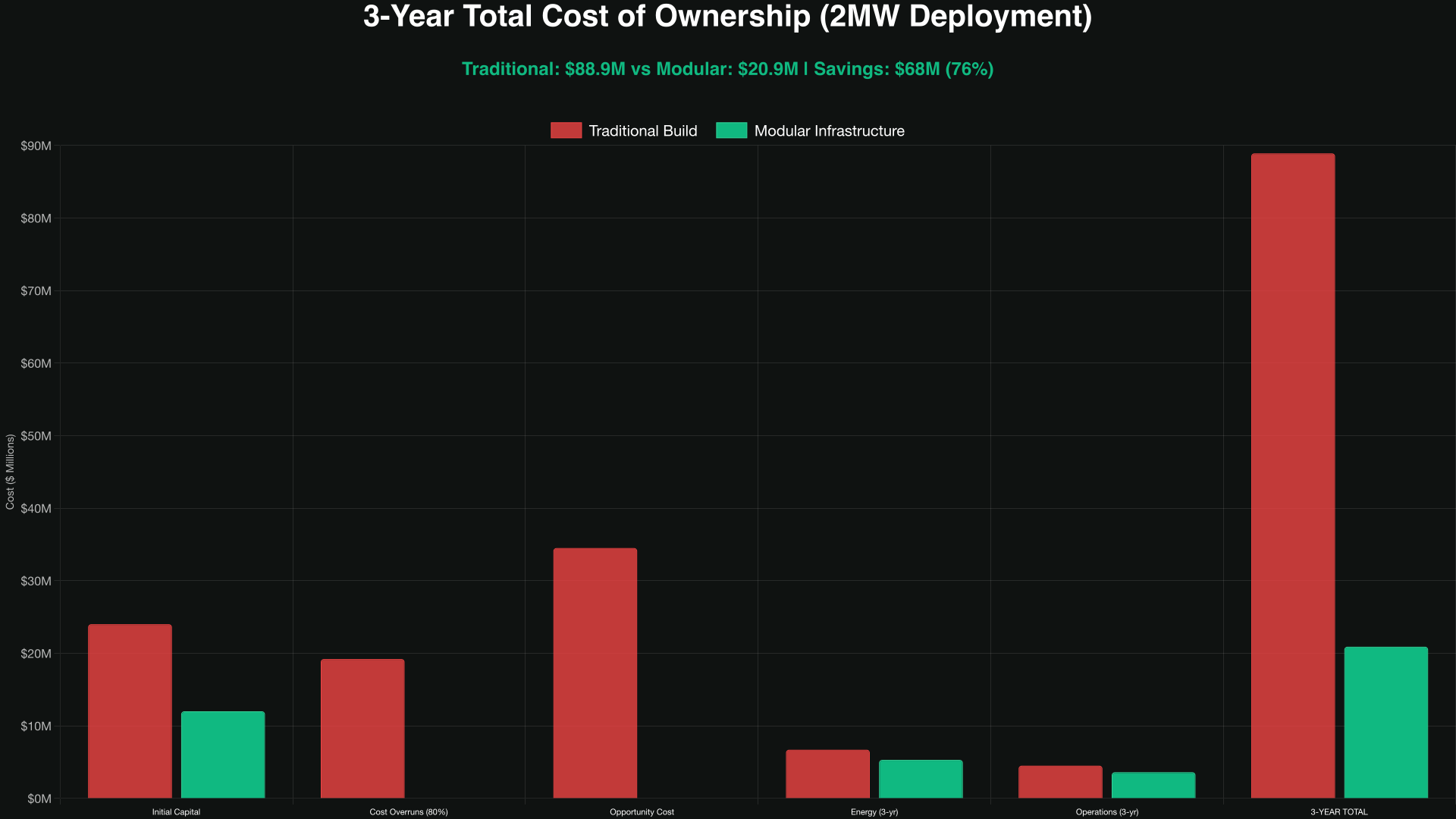
Understanding true total cost of ownership requires looking beyond initial capital expenditure to include opportunity costs, operational efficiency, and risk factors:
Hidden Cost Factors
Opportunity Cost of Delayed Deployment
If your AI infrastructure generates $2.3M per month in revenue (industry average for mid-size deployments), a 12-month deployment delay costs $27.6M in lost revenue opportunity.
Traditional build starting today: operational Q3-Q4 2027 = 15-18 months of opportunity cost = $34.5-41.4M
Modular deployment starting today: operational within 3-4 months = 2-3 months opportunity cost = $4.6-6.9M
Opportunity Cost Savings: $27.6M to $34.5M
Construction Cost Overrun Risk
Based on construction industry data, 98% of megaprojects face cost overruns averaging 80%. For a $20M traditional build, this means:
- • Budgeted cost: $20M
- • Expected overrun (80%): +$16M
- • Actual total cost: $36M
Modular deployments have fixed pricing. A $12M modular quote remains $12M at delivery.
Cost Certainty Value: $16M saved from eliminated overruns
Operational Efficiency (PUE)
Modern liquid-cooled modular infrastructure achieves PUE of 1.2-1.3 versus 1.5-1.7 for traditional air-cooled facilities. For a 2MW facility running at 80% utilization:
- • Annual IT load: 1.6MW × 8,760 hours = 14,016 MWh
- • Traditional facility (PUE 1.6): 22,426 MWh total = 8,410 MWh overhead
- • Modular facility (PUE 1.25): 17,520 MWh total = 3,504 MWh overhead
- • Power cost savings: 4,906 MWh × $0.10/kWh = $490,600 per year
3-Year Energy Savings: $1.47M
3-Year TCO Comparison (2MW Deployment)
| Cost Factor | Traditional Build | Modular Container | Savings |
|---|---|---|---|
| Initial Capital | $24M | $12M | $12M |
| Cost Overruns (avg 80%) | $19.2M | $0 | $19.2M |
| Opportunity Cost (15 mo delay) | $34.5M | $0 | $34.5M |
| 3-Year Energy Costs | $6.7M | $5.3M | $1.4M |
| 3-Year Operations & Maintenance | $4.5M | $3.6M | $0.9M |
| Total 3-Year TCO | $88.9M | $20.9M | $68M |
The modular approach delivers $68M in total savings over 3 years for a 2MW deployment when accounting for opportunity costs, construction overruns, and operational efficiency. Even excluding opportunity costs, the savings exceed $30M.
Industry Examples: Modular in Production
Modular data center infrastructure isn't experimental. Global technology leaders have deployed container-based and modular facilities at scale:
Google's Container Data Centers
Google pioneered container-based data center design, deploying shipping container modules with pre-integrated servers, networking, and cooling. This approach enables rapid deployment and standardized operations across global facilities.
Source: Google data center public documentation, Data Center Knowledge archives
Microsoft Azure Modular Facilities
Microsoft uses modular construction techniques for Azure expansion, reducing deployment timelines from 18-24 months to 6-12 months. Standardized modules enable consistent quality and predictable costs across regions.
Source: Microsoft Azure blog, industry press releases
Schneider Electric EcoStruxure Modular
Schneider Electric's prefabricated data center modules serve enterprise clients across telecommunications, healthcare, and financial services. Deployments are 40-60% faster than traditional builds with fixed pricing and factory testing.
Source: Schneider Electric public case studies
EdgeConneX Modular Edge Facilities
EdgeConneX deployed 40+ edge data centers using modular and prefabricated components, achieving consistent quality and accelerated timelines. Standardization enables rapid scaling across markets.
Source: EdgeConneX press releases, Data Center Dynamics
These examples demonstrate that modular infrastructure is not just viable but preferred by organizations that prioritize speed, cost certainty, and operational efficiency. The technology is proven at hyperscale and now available to enterprises without hyperscaler budgets.
Your 2026 Infrastructure Decision
The path you choose in Q1 2026 determines your competitive position for the next 24 months. Here's how to make the decision:
Assess Your Timeline Requirements
When do you need production capacity operational? If the answer is within 2026, traditional builds are not viable. Modular or colocation are your only realistic options.
Calculate True Total Cost of Ownership
Use our interactive TCO calculator to model your specific scenario. Include opportunity costs, overrun risk, and operational efficiency differences.
Evaluate Internal Capabilities
Download our 47-point AI Readiness Checklist to honestly assess whether your team has data center construction and operations expertise.
Consider Hybrid Approaches
You don't need to choose just one path. Many enterprises start with colocation for immediate needs, add modular capacity for medium-term scale, and maintain cloud for geographic distribution.
Make the Decision in Q1
Every month of delay in Q1 2026 pushes your deployment timeline further into 2027 (traditional) or Q4 2026 (modular). The cost of indecision is measurable in lost revenue and competitive disadvantage.
Conclusion
The 2026 AI infrastructure market is moving faster than traditional deployment timelines can support. Organizations that recognize this reality and adopt modular, colocation, or hybrid strategies will capture market share while competitors wait for traditional builds to complete in 2027 or 2028.
With AI infrastructure spending reaching $280 billion in 2026 and growing 19% annually, the timeline advantage of modular deployment translates directly to competitive advantage. The question is not whether you'll deploy AI infrastructure, but whether you'll deploy it in time to matter.
Make your decision in Q1 2026. Every month counts.
Sources & References
Ready to Plan Your 2026 AI Infrastructure Deployment?
Use our tools and resources to make data-driven infrastructure decisions. Calculate your total cost of ownership, assess your readiness, and explore deployment options that fit your timeline.