Three sizes, built and tested in the factory. Ready for service in 4 to 8 months
against 18 to 24 for a conventional build, liquid cooled to 250 kW per rack, and
added one block at a time as capacity is contracted.
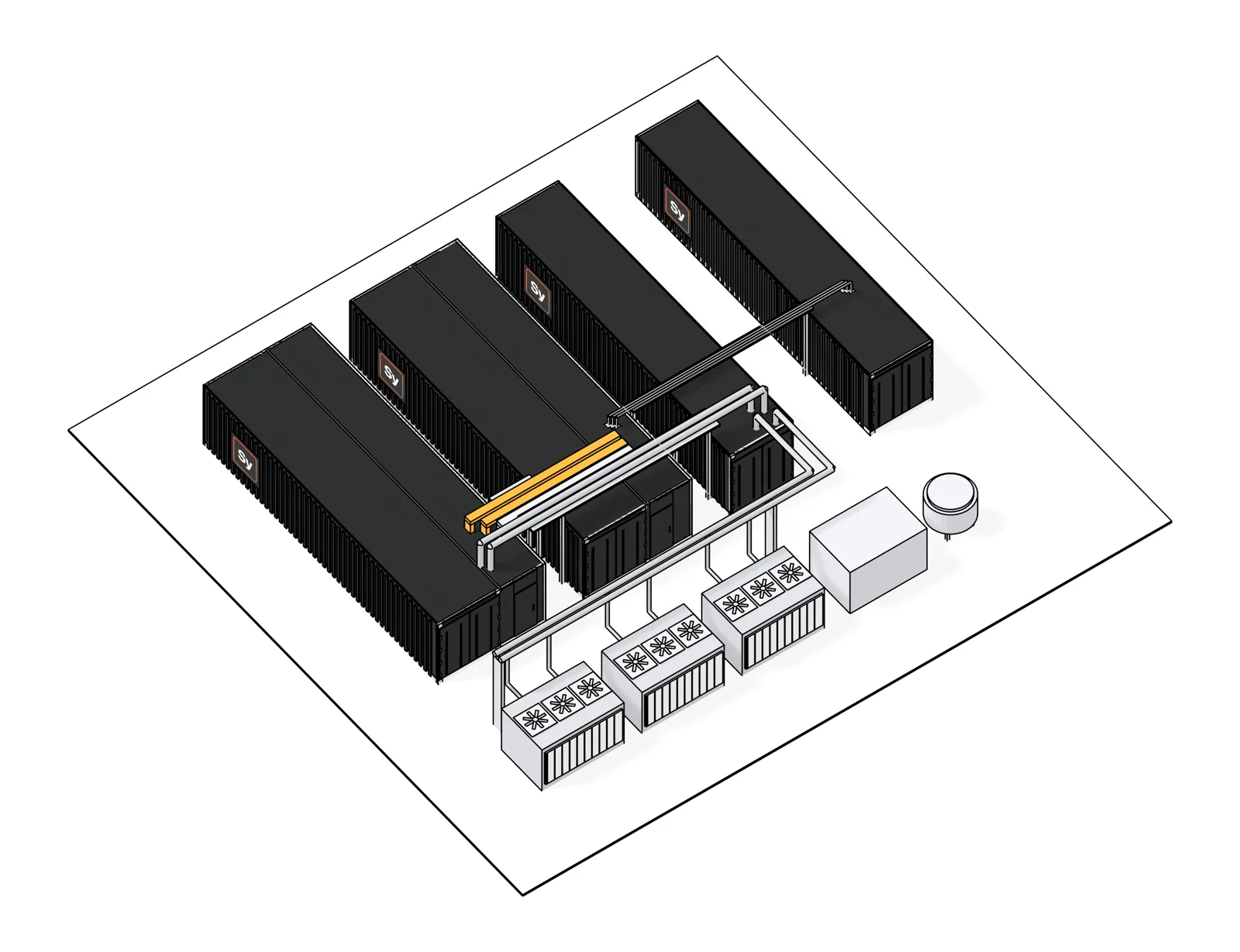
The building block
1.6 MW Block
The step that repeats. Its own power, battery and cooling plant, sized for GB300 NVL72 class racks and added one block at a time.
IT capacity
1.6 MW
Rack positions
8 at up to 200 kW
Redundancy
N+1, or 2N
Land
0.08 to 0.15 acre
Land: modules and coolers, from the bare pad to the pad with its service perimeter. Transformer, access, setbacks and permitting vary by site.
ProblemPower and buildings take years, and GPU capital loses value every month it waits.
Faster to site. Cheaper per MW.
Speed
75% faster
to site than a conventional build
3 to 6 months
from order to modules delivered on site
06121824
Conventional build18 to 24 months
Syaala, delivered to site3 to 6 months
Months
Modules are built and tested in the factory while the site is prepared, so the two run side
by side instead of one after the other. Ready for service follows in 4 to 8 months
from order.
Conventional build: average construction time, Turner and Townsend Data Centre Cost Index
2024, before any utility wait. Site gates such as utility energisation, carrier fibre and permits can pace the date, and are stated in the written site fit.
Cost
50% cheaper
per MW than industry-leading conventional builds
Factory acceptance tested
Tested again on site
NRTL evaluation per project
Designed to NEC and NFPA
Battery to UL 9540 and NFPA 855
Pay as you grow
Capacity is added one block at a time as it is contracted, not a whole building ahead of demand.
Factory hours, not field hours
Power, cooling and IT rooms arrive built and tested. Site work comes down to the pad, the connections and commissioning.
No cooling towers
GPU heat leaves on a warm-water loop to dry or adiabatic coolers, with water used only for adiabatic assist at high ambient.
One design, repeated
The same engineered block on every site: the design, the drawings and the test programme are reused, not redone.
What waiting costs
$0.8M to $2.0M
per MW, every month a GB300 cluster waits for power
Compared with conventional data center construction at $8 million to $12 million per MW of IT (Cushman and Wakefield, U.S. Data Center Development Cost Guide 2025). Syaala prices each project in writing after a site fit. Basis: GB300 NVL72 rack capital of $5.0 million to $6.5 million at 132 to 140 kW ($36 million to $49 million per MW of IT), a 10 to 15 percent cost of capital and a three to six year economic life. Indicative, not a quotation.
Density and compatibility
ProblemGPU racks now draw 130 kW and more, far beyond what an air-cooled hall was built to carry.
Built around the rack, up to 250 kW.
Every size runs direct-to-chip liquid cooling on a warm-water loop, with a separate circuit
for the small share of heat left in the air. Rack count and density are set within each size:
fewer racks at higher density, or more at lower.
GB300 NVL72 class130 to 150 kW
HGX B300, liquid cooled150 kW
1.6 MW Block positionprovisioned to 200 kW
Vera Rubin NVL72 classup to 250 kW
050100150200250
kW per rack
Matched to the rack
Designed for NVIDIA GB300 NVL72, HGX B300 and Vera Rubin NVL72 class platforms, including
the rack-scale systems Supermicro, Dell, Lenovo and HPE build on them. On every project the
design is checked against the rack maker's facility specification: power feed, liquid
connections, coolant flow and supply temperature.
Configured to the project
Rack platform and density per position
Redundancy: N+1, or 2N on the 1.6 MW Block
Heat rejection selected for the site climate
Utility, site generation or bridge power at the module interface
Platforms mixed pod by pod in the 9 MW Zone
Building management and power monitoring built in
NVIDIA, GB300, HGX, Vera Rubin, Supermicro, Dell, Lenovo and HPE are trademarks of their owners.
They are named to describe compatibility; no endorsement, certification or reference design
programme is implied. Densities are indicative design values and vary with rack selection and
GPU generation.
Servicing
ProblemDense modules are cramped: once a room is full, racks and power gear are hard to reach.
Ships narrow. Opens wide for service.
The IT and power modules of the 1.6 MW Block travel at standard shipping width on ordinary
trucks, with no over-width permits. On site, a side extension opens each room to its full
working width.
Zones only, not to scale. Illustrative of the 1.6 MW Block IT module.
Racks roll straight in
A clear front aisle gives every rack a straight route in and out, with nothing overhead in the way.
Connections from behind
Power and cooling connections sit on a separate service aisle inside the extension, away from the rack fronts.
Service while it runs
Power modules, pumps and coolers are N+1, so any one can come out for service while the block carries its load. An N+1 block runs at N during maintenance; the 2N option keeps a full second path.
Batteries in their own module
Energy storage sits in a separate module outside the IT room, designed to UL 9540 and NFPA 855.
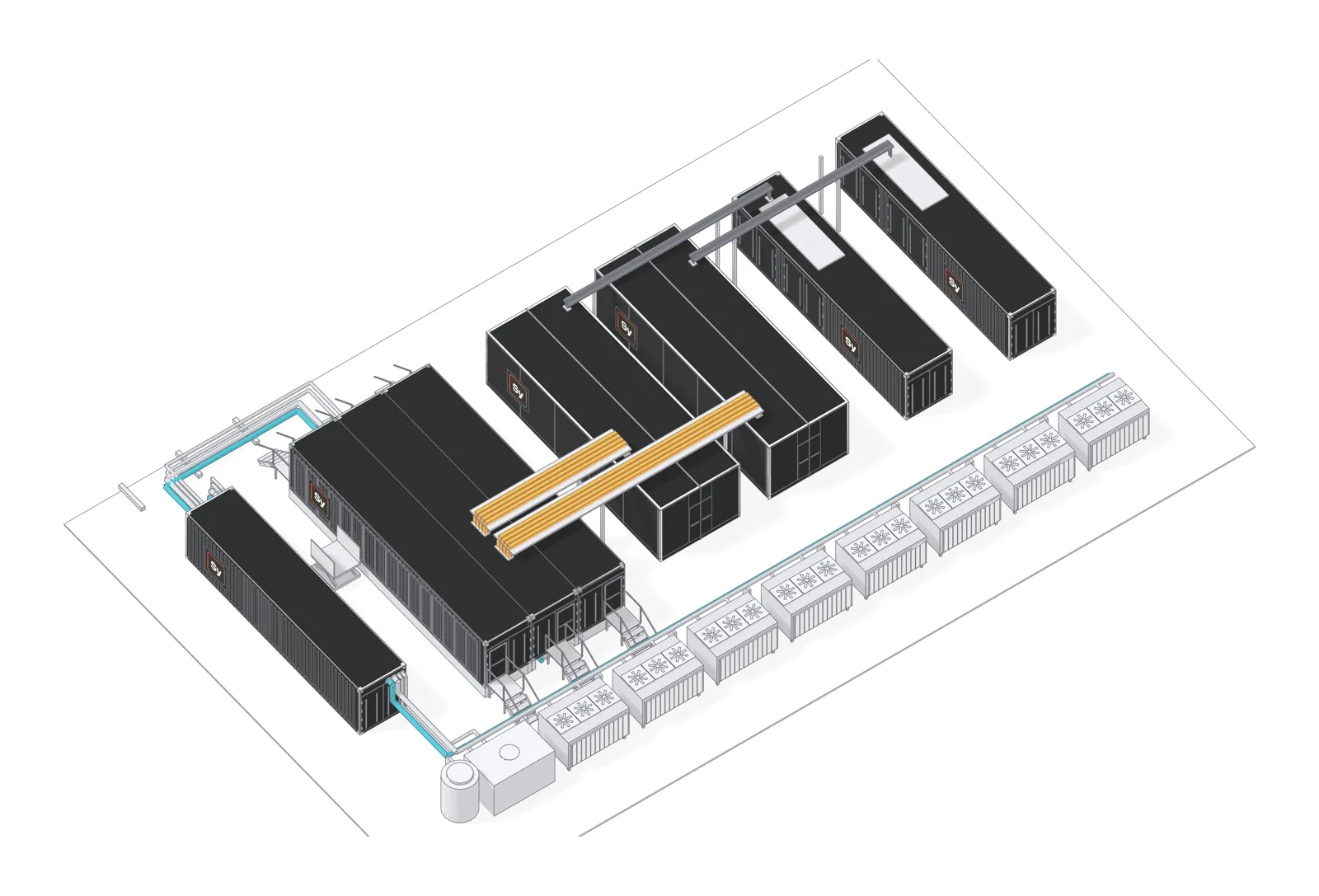
The 4.8 MW B300 Block is serviced around a central spine: racks load from its two wings, cooling
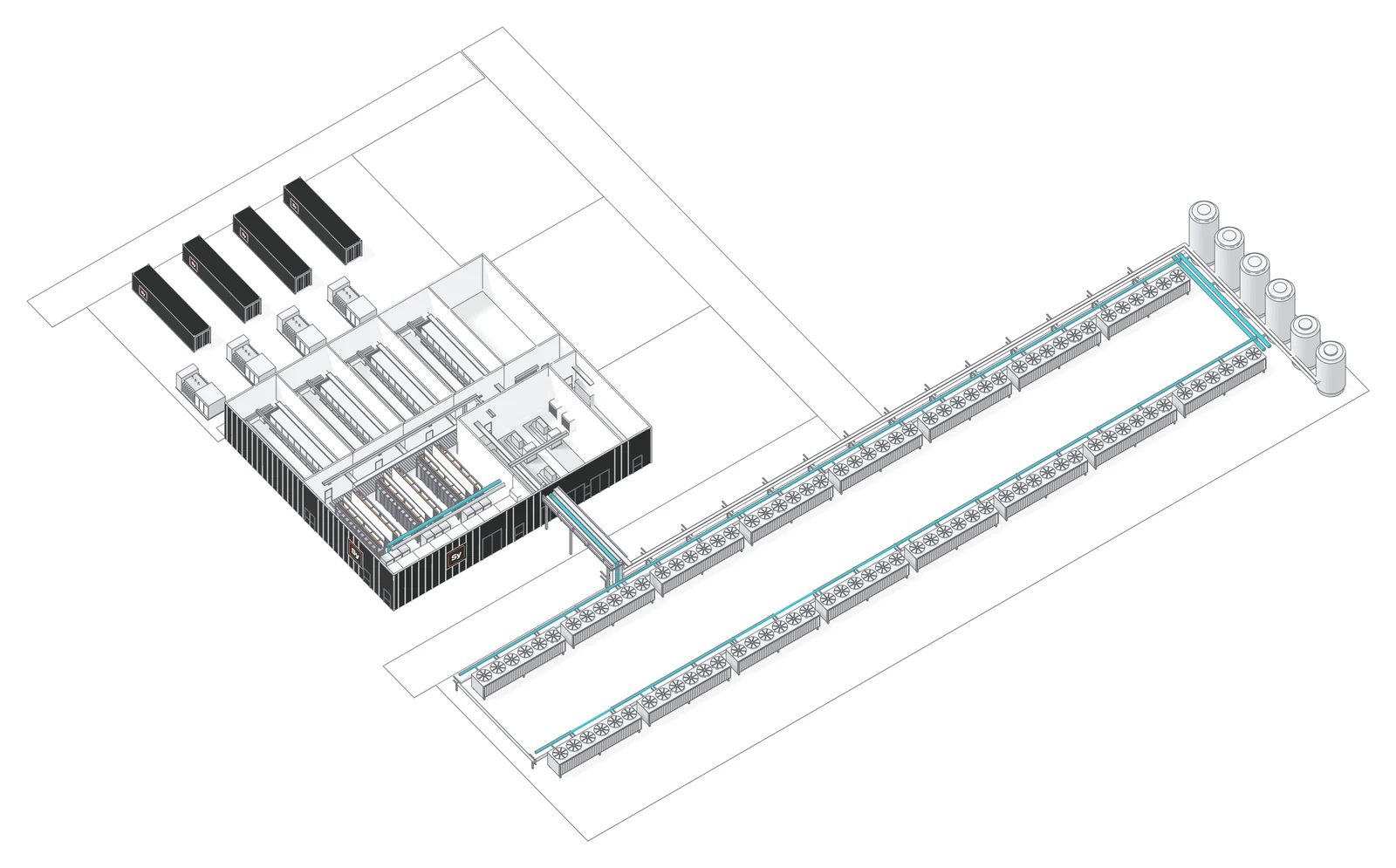
water runs under the floor and power overhead. The 9 MW Zone sits in a one-storey hall and is
serviced like a data hall.
Build and test
ProblemA stick-built site is tested only at the end, when every fault costs the most time.
Tested in the factory. Proven again on site.
The technical datasheet covers all three sizes: modules, rack densities, redundancy and site fit.
Order
In the factory
Build
Factory acceptance test
Ship
On site
Site works and utility
Set and join
Commission
Integrated systems test
Ready for service4 to 8 months
In the factory
A factory acceptance test for every module before it ships, on load banks and witnessed by Syaala
The test programme takes each power module, pump and cooler out in turn to show the load still holds
Third-party (NRTL) evaluation, arranged per project
On site
Staged energisation and commissioning, block by block
An integrated systems test with site generation and fibre
Site acceptance with your racks installed
A documentation package at handover
Designed to
NEC (National Electrical Code) and NFPA requirements
UL 9540 and NFPA 855 for battery storage
ASHRAE TC 9.9 thermal guidelines
Site gates such as utility energisation, carrier fibre and permits can pace the date, and are stated in the written site fit.
For site owners
ProblemA 5 to 50 MW site is too small for a hyperscale campus, so good power goes unused.
Have a site with power? Put AI capacity on it.
The platform is sized for power-ready land from a few megawatts to about 50 MW. Time to power
matters more than size, so the first question for any site is when it can be energised.
About 5 MW of IT
Three 1.6 MW Blocks, or one 4.8 MW B300 Block
10 MW and up
A 9 MW Zone, opened in thirds from 3 MW, or blocks added side by side
20 to 50 MW
Zones and blocks added in place, phase by phase, as capacity is contracted
Figures are IT capacity. Site power is sized above the IT load for cooling and losses, and the
written site fit states it.
Land per unit
1.6 MW Block
0.08 to 0.15 acreModules and coolers, from the bare pad to the pad with its service perimeter
4.8 MW B300 Block
0.17 to 0.26 acreModules and coolers, from the bare pad to the pad with its service perimeter
9 MW Zone
1.5 to 3.7 acresHall, substations, batteries and cooler yard, up to a reference site with roads
Land varies by site: the transformer, generation, access road, setbacks and any easements come on top of the block figures, and local permitting sets the final layout.
Site types and the sizes that suit them
Site type
Why it fits
Best match
Energised industrial and brownfield sites
Former mining, mill and manufacturing sites with an existing interconnection or utility contract. The fastest route to power.
All three sizes
Power-ready greenfield and campus land
A utility feeder and room to repeat. Blocks add in place; a zone suits a campus with a building shell.
Blocks; the Zone from 10 MW
Sites where the grid date is the gate
Power can start on site generation or a bridge supply and step down to the utility when it arrives.
1.6 MW and 4.8 MW Blocks
Metro and building-based sites
Limited land, or an existing building. A single block needs little room; the zone fits a one-storey hall.
1.6 MW Block; 9 MW Zone
The site provides
Utility power, with generation sized per site
A site transformer at 480 V for the 1.6 MW Block or 415 V for the B300 Block; medium voltage for the 9 MW Zone
Network and fibre into the site
A prepared pad and site works
Chilled water for residual air heat (blocks only)
A one-storey hall, for the 9 MW Zone only
Syaala provides
A written site fit before any order
The modules, matched to your racks and tested in the factory
Delivery to site
The commissioning and test programme through site acceptance
Equipment financing for qualified projects
What it is used for
AI training on dense GB300, B300 and Vera Rubin clusters
High-throughput inference at 130 kW per rack and up
GPU clouds adding capacity one step at a time as demand is contracted
Enterprise and sovereign AI that needs capacity under its own control
Questions
Modular data centers, answered.
What is a modular data center?
A data center built from factory-made modules. The power, cooling and IT parts are built and tested in a factory, then set on a prepared site and joined. Syaala modular data centers come in three sizes, 1.6 MW, 4.8 MW and 9 MW, all with direct-to-chip liquid cooling for GPU racks.
How long does a modular data center take to deploy?
Typically 4 to 8 months from order to ready for service, depending on equipment reservation and site readiness. Site gates such as utility energisation, carrier fibre and permits can pace the date, and are stated in the written site fit.
What rack densities are supported?
130 kW to 250 kW per rack on a direct-to-chip warm-water loop. GB300 NVL72 class racks run at about 150 kW, HGX B300 racks at 150 kW, and Vera Rubin class racks up to 250 kW in the 9 MW Zone.
How do the 1.6 MW Block, the 4.8 MW B300 Block and the 9 MW Zone differ?
The 1.6 MW Block is the step that repeats: eight rack positions with their own power, battery and cooling plant, N+1 or 2N. The 4.8 MW B300 Block carries 32 liquid-cooled HGX B300 racks at 150 kW, N+1 in each half. The 9 MW Zone places factory-built power and cooling kits in a hall of three pods with four power paths, any three of which carry the load.
Is a modular data center the same as a containerized data center?
A containerized data center is one kind of modular data center. Each Syaala size is engineered as a complete system for liquid-cooled GPUs, with its IT, power, battery and cooling modules sized together, and the 9 MW Zone puts factory-built kits inside a one-storey hall.
How does capacity grow?
Blocks and zones add in place on the same site, from one block to a 50 MW campus. The 9 MW Zone opens in thirds, from 3 MW.
What redundancy is standard?
N+1 on power and cooling as standard, with a 2N option with separate A and B paths on the 1.6 MW Block. The 4.8 MW B300 Block is N+1 in each half, and the 9 MW Zone has four power paths, any three of which carry it.
Which GPU platforms and servers does it support?
NVIDIA GB300 NVL72, HGX B300 and Vera Rubin NVL72 class platforms, including the rack-scale systems Supermicro, Dell, Lenovo and HPE build on them. Each project is checked against the rack maker's facility specification for power, liquid connections, coolant flow and supply temperature. The names describe compatibility; no endorsement or certification is implied.
How are the modules tested?
Twice. The test programme puts every module through a factory acceptance test on load banks before it ships, taking each power module, pump and cooler out in turn to show the load still holds, and third-party (NRTL) evaluation is arranged per project. On site it continues with staged commissioning, an integrated systems test with site generation and fibre, and site acceptance with the racks installed.
Can the modules be serviced while they run?
Yes. Power modules, pumps and coolers are N+1, so any one can be taken out while the block carries its load (an N+1 block runs at N during maintenance; the 2N option keeps a full second path). On the 1.6 MW Block a side extension opens on site to give a clear rack aisle and a separate service aisle for power and cooling connections.
What does the site need to provide?
Utility power with generation sized per site, a site transformer at 480 V for the 1.6 MW Block or 415 V for the B300 Block (medium voltage for the 9 MW Zone), network and fibre, a prepared pad and site works, and chilled water for residual air heat on the blocks. The 9 MW Zone also needs a one-storey hall built by the site contractor.
Is financing available?
Equipment financing is available for qualified projects. Ask for it with a specification request and it is scoped with the site fit.
Have a site in mind
Tell us the power, the racks and the date.
Share what you know. Every field is optional, and the reply is a written site fit for the size that suits it.